VALORANT Champions Shanghai Group Stage Day 8 Recap
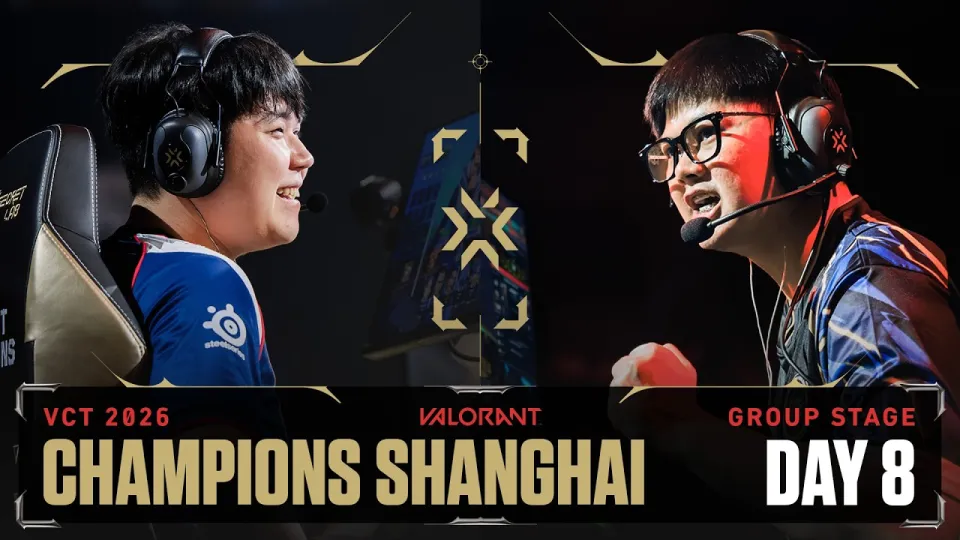
Video: VALORANT Champions Shanghai — Group Stage — Day 8
Want articles like this for your own video to promote it on YouTube and Google? Order them through the Telegram bot @sat_sit_bot. The bot writes and publishes the articles itself (with your YouTube video embedded) on popular topical websites (no ads). Free trial — 50 articles.
· based on the channel VALORANT Champions Tour
VALORANT is Riot Games' 5v5 tactical shooter where two teams of agents fight over spike plants and round economy, and at Champions Shanghai the group stage decides which of 16 squads reach the playoff bracket. Day 8 of the group stage, published by the VALORANT Champions Tour channel, closed out the opening phase with T1 versus JD Gaming and the last remaining qualification spots. For live bracket updates, schedules and announcements, the official hub is VALORANT Esports on X.
What the Day 8 broadcast covers
Day 8 is the final stretch of group play, and the VOD runs through a full best-of-three between T1 and JD Gaming plus the surrounding matches that decide seeding. The broadcast structure follows the standard VCT format: a short desk segment, map veto, then the series itself with analyst breakdowns between maps.
Three things define the day:
- The T1 vs JD Gaming series goes the distance, with the third map deciding the result.
- A technical pause halts play early in the first map while the production team resolves an issue.
- The day's results finalize which teams advance and which go home, closing the group stage entirely.
Because the group stage is round-robin, Day 8 also settles tiebreakers. Map differential and head-to-head results matter as much as raw wins, which is why a single lost map can flip a seeding line even when the series itself is already decided.
T1 vs JD Gaming and the CN question
JD Gaming entered the series with a real chance to take it 2-0, and that near-miss became the talking point of the day. The Chinese side built a lead on the opening map and let it slip, a swing that changed the entire shape of the series and forced the decider.
That collapse matters beyond one match. All four Chinese teams were eliminated during the group stage, and the reaction from viewers was blunt: a home event in Shanghai with no home team left standing. The counterargument is equally simple. Playing on home soil adds pressure rather than removing it, and the gap between CN and the top of EMEA, Americas and Pacific is still measurable in mid-round discipline and clutch execution, not in raw aim.
The JD Gaming series is the clearest illustration. A 2-0 there would have been an unusual result for the region on the global stage, and the fact that it slipped away says more about closing out maps than about talent.
The technical pause and broadcast complaints
A technical pause stopped play early in the first map, and the VOD preserves the dead air along with the production team's attempts to fill it. Pauses are routine in a live server environment, but they break momentum, and teams handle the reset differently depending on who was ahead when the clock stopped.
Viewers raised two other recurring complaints about the broadcast:
- Hit registration disputes, where a shot that looked like a headshot on the client-side replay only registered as a body shot on the server.
- Observer cuts that miss a kill or switch away mid-duel, which makes it hard to verify what actually happened in a round.
Neither is unique to this event, and neither is evidence of anything beyond the usual gap between what a player sees and what the server records. Still, they are the kind of details that decide rounds at this level, so they get scrutinized.
Agent picks and role experiments
One of the more surprising decisions of the day was putting a player known for a non-duelist role onto a duelist agent. Role swaps like this are common in the group stage, where teams test compositions they may need later in a bracket run, but they still raise eyebrows when the player in question has built a reputation elsewhere.
The reasoning is usually structural. A duelist entry creates space, and a player with strong utility timing can convert that space into map control more efficiently than a pure fragger. Whether it works depends on how the rest of the composition supports the entry, particularly on the sentinel and controller side.
Other picks worth noting from the day include compositions built around silencing enemy utility, a detail that drew more praise from viewers than almost anything else in the series. Shutting down a key ultimate or a signature ability at the right moment often decides a round more cleanly than a multikill.
Reading the VOD without spoilers
The broadcast opens with a spoiler block for viewers who want to watch the series blind, followed by the match itself. If you are watching after the fact, the structure is straightforward: the first map, the technical pause, then the second and third maps, with the T1 vs JD Gaming series occupying the back half of the stream.
For anyone using the VOD to study the meta rather than the results, the useful sections are the map veto and the between-map analysis. That is where coaches and analysts explain why a composition was chosen and what a team was trying to punish, which is far more transferable to your own ranked games than the highlight reel.
Common questions from the chat
Several themes came up repeatedly in viewer discussion, and they are worth addressing directly because they apply to most VCT broadcasts, not just this one.
Why do Chinese teams struggle at international events? The gap is rarely mechanical. It shows up in mid-round calling, default setups and how teams trade advantages, all of which are punished harder against EMEA and Pacific opposition than in regional play.
Why do technical pauses take so long? A pause usually involves verifying server state, confirming both teams are ready and rebuilding whatever was lost. Riot's rules cap how long a pause can run before a decision is forced, but the clock is not visible to viewers.
Why does the kill feed disagree with the replay? Client-side prediction and server-side tick rate do not always match frame for frame. The server is authoritative, so what it records is what counts.
Is a home crowd an advantage or a disadvantage? Both. It raises energy and it raises stakes, and for a young roster the second effect often wins out.
Useful links
- Official X account: https://x.com/valorantesports
- Facebook: https://www.facebook.com/ValorantEsports/
- Instagram: https://www.instagram.com/valorantesports/
- TikTok: https://www.tiktok.com/@valorantesports
- Twitch: https://www.twitch.tv/valorant
Closing thoughts on Champions Shanghai group play
Day 8 closed the group stage with the bracket finally set, and it did so the way most decisive days do: one series that should have been a sweep turned into a grind, and a region's hopes ended on a map they had controlled. The T1 vs JD Gaming match is the one to watch if you only have time for a single series, because it contains the whole story of the day in three maps. The broadcast, produced by the VALORANT Champions Tour, also doubles as a useful study of how top teams draft compositions under pressure. For schedules, bracket updates and everything that follows, follow VALORANT Esports on X.
Key takeaways
- VALORANT Champions Shanghai runs September 24 to October 18 with 16 teams from Americas, CN, EMEA and Pacific.
- Day 8 of the group stage features T1 vs JD Gaming, a three-map series decided on the final map.
- All four Chinese representatives were eliminated in the group stage, leaving CN without a playoff team.
- A technical pause interrupted the broadcast during the opening map of the day.
- Follow official updates and bracket info via https://x.com/valorantesports.
Questions & answers
Which series headlined Day 8 of the VALORANT Champions Shanghai group stage?
T1 vs JD Gaming was the marquee series of the day and it went to a deciding third map. JD Gaming had a genuine path to a 2-0 after building a lead on the opening map, but lost control of it, which shifted the entire series. The result helped finalize the playoff bracket.
Why were all the Chinese teams eliminated in the group stage?
The short answer is execution under pressure rather than raw skill. Chinese rosters matched their opponents mechanically in several maps but lost mid-round discipline, failed to close leads and struggled in clutch situations against EMEA, Americas and Pacific teams. Playing at a home event in Shanghai added pressure instead of relieving it.
What caused the technical pause during the broadcast?
A technical pause halted play early in the first map of the day, and the VOD keeps the downtime intact. Pauses at this level usually involve verifying server state and confirming both teams are ready to resume. They break momentum, which can favor whichever side was trailing when the clock stopped.
Do professional role swaps, like a non-duelist player picking a duelist, actually work?
They can, and the group stage is exactly where teams test them. A player with strong utility timing can convert entry space into map control more efficiently than a pure fragger, provided the sentinel and controller picks support the aggression. If the rest of the composition does not enable the entry, the swap backfires.
Source: VALORANT Champions Shanghai — Group Stage — Day 8 · Markdown version